

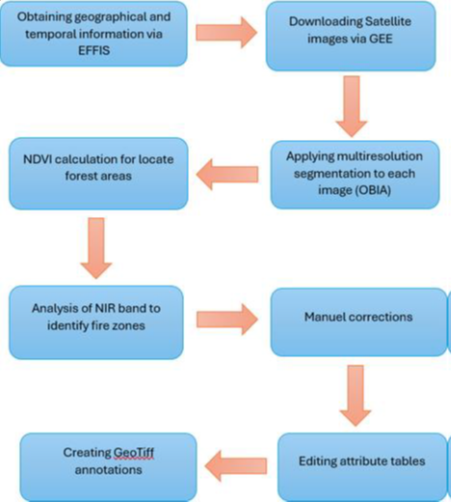
The Turkish consortium monitored and analysed abiotic and biotic factors adversely affecting forest ecosystems, with particular emphasis on burn severity mapping. Satellite imagery, including data from the Copernicus Sentinel programme, was used for this purpose. Figure 1 shows the procedure used in this regard.
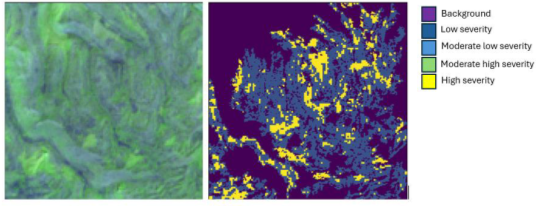
As a result of these works, maps were created showing the degree of damage to the forest. Figure 2 shows an example of such a map for an area affected by a forest fire.
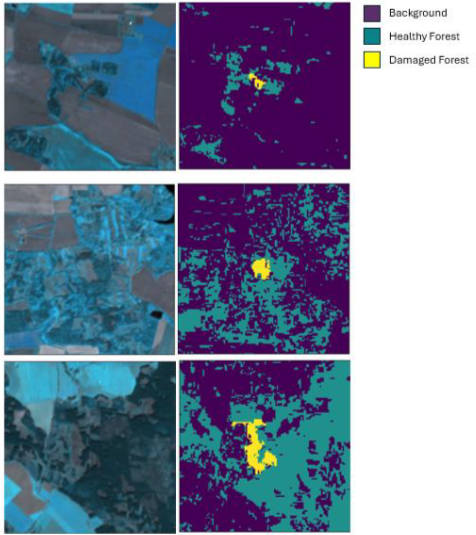
The monitored and studied biotic factor is Insect Damage Detection. Satellite imagery and artificial intelligence were used for this purpose. An example map obtained as a result of these tests is presented in Figure 3.
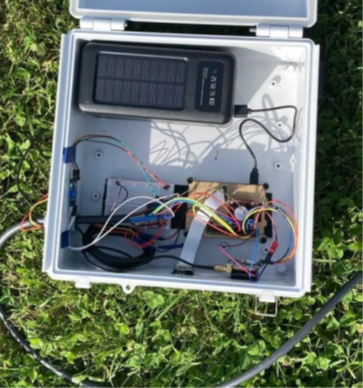
Monitoring of forest disruptors with sensors designed and constructed by the Turkish consortium. The main part of the system was the so-called IoT Sensor Box. Figure 4 shows a prototype of the IoT sensor box.
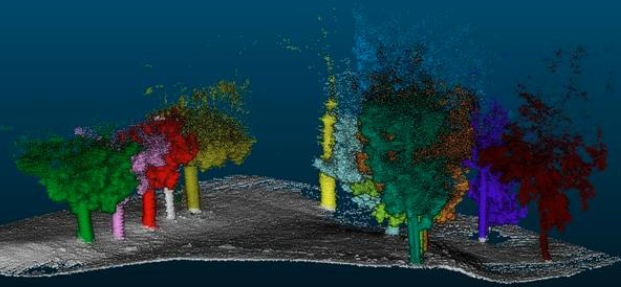
The monitoring of the research fields by the Turkish consortium was carried out not only using satellite imagery but also based on field measurements in the forest (Mobile Mapping). Figure 5 shows an example of a classified cloud of mobile laser scanning of a forest. The classification was carried out using artificial intelligence methods.
The installed IoT system for forest monitoring will function in the long term, providing the data necessary to simulate forest ecosystems, which in turn will enable forecasting of their future functioning under the conditions of progressive climate change.